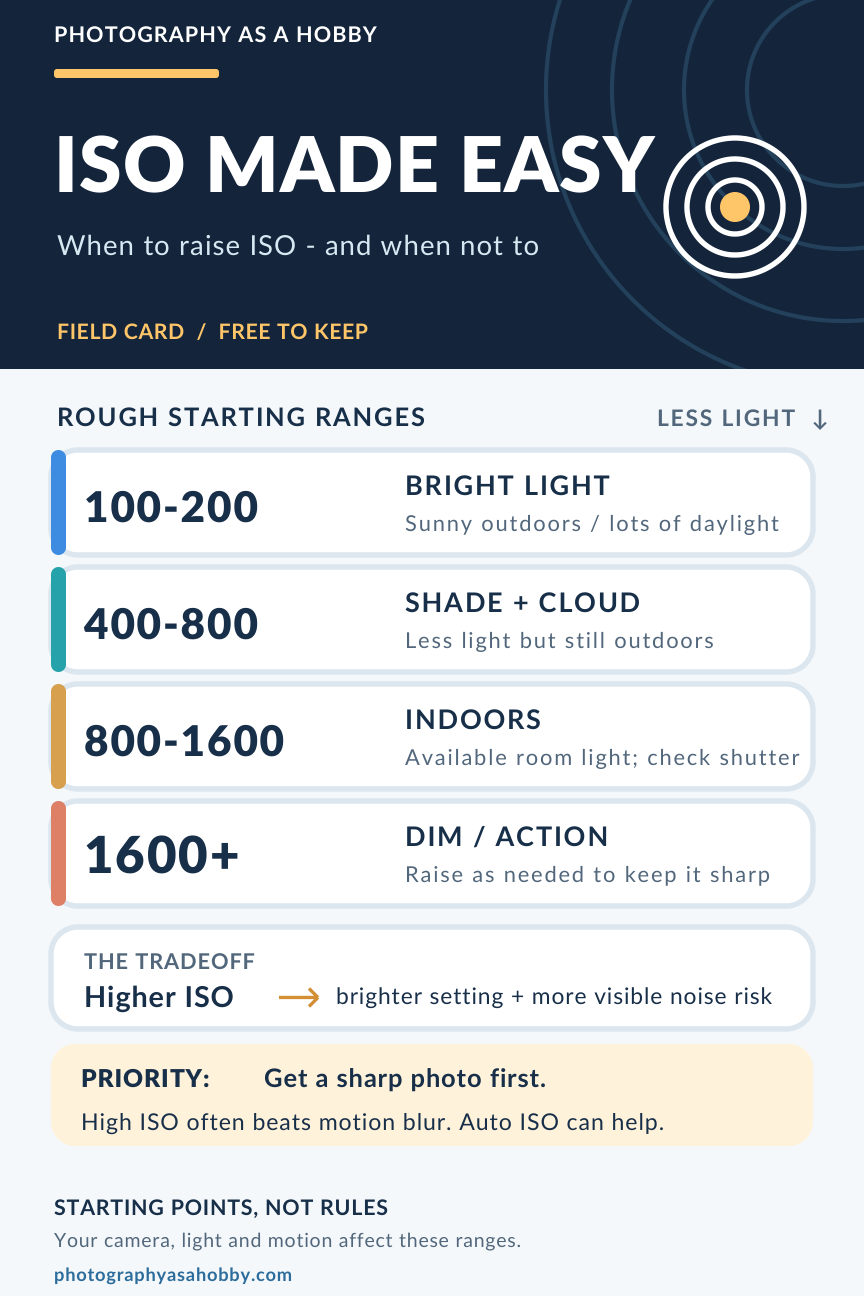
Free ISO Cheat Sheets
Keep a simple ISO guide close while you learn. Choose the compact camera-bag card or the letter-size sheet with both ISO and shutter-speed references.
Both files are free PDFs. Print at actual size for the intended card dimensions.
ISO is the camera setting that changes how strongly the image signal is amplified and processed. Raising ISO makes it easier to create a usable exposure when light is limited, but higher ISO generally comes with a reduction in image quality.
What changes when ISO goes up?
The image can be made brighter without changing aperture or shutter speed. That is useful when you need a shutter speed fast enough to stop motion or an aperture small enough to hold enough of the scene in focus.
Why does high ISO look noisy?
In low light, the sensor captures a weaker signal relative to noise. Raising ISO does not create the noise by itself, but it amplifies the recorded signal and makes noise more visible. Modern cameras and editing software can handle high ISO much better than older systems, but there is still a tradeoff.
Is ISO 100 always better?
Not if ISO 100 forces a shutter speed that causes motion blur. A sharp photograph at ISO 3200 can be more useful than a blurry photograph at ISO 100.
What is Auto ISO?
Auto ISO lets the camera choose ISO within limits you set. It is a very useful learning tool because you can control aperture or shutter speed while allowing the camera to compensate for changing light.
When should a beginner raise ISO?
- When the shutter speed is too slow for subject motion.
- When a smaller aperture is needed for depth of field.
- When adding more light is not practical.
- When using a faster lens or tripod is not an option.