Want a quick starting point? Use the tool first, then read the detailed beginner explanation below to understand how shutter speed changes motion and light.
What Shutter Speed Should I Try?
Choose what you are photographing, your lens, and the look you want. The result is a sensible first setting—not a strict rule.
Why: A still subject and normal lens give you room to use a moderate handheld speed.
Light check: If the photo is dark, raise ISO, open the aperture, or add light.
Remember: This is a starting point, not a strict rule. Subject speed, distance, technique, stabilization, and available light all matter.
Shutter Speed Cheat Sheet
Move toward faster numbers to freeze action. Move toward slower numbers when you want visible motion.
Using a longer lens? Camera movement is magnified when you zoom in, so start one step faster when handholding.
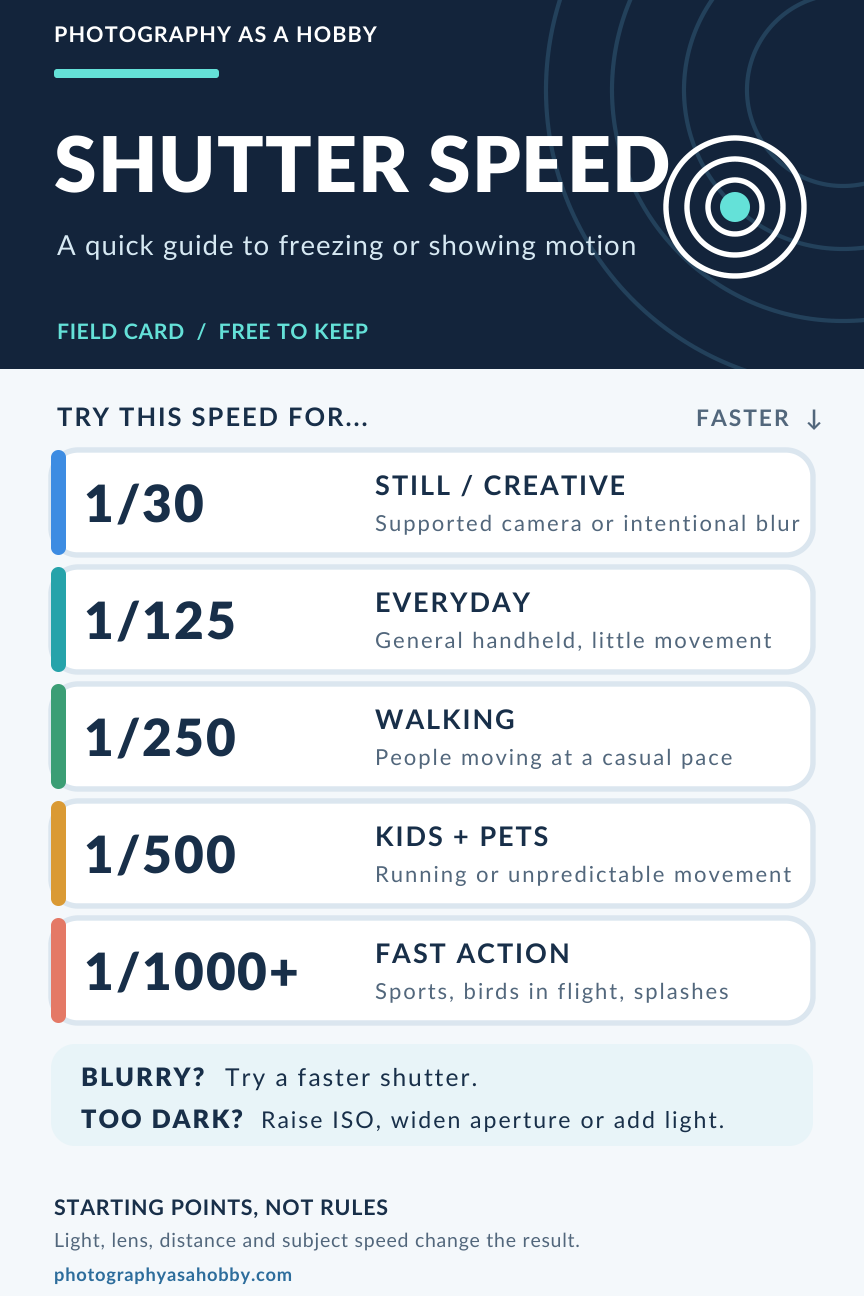
Free Shutter Speed Cheat Sheets
Keep the starting speeds handy while you practice. Choose the compact camera-bag card or the letter-size sheet with both shutter speed and ISO references.
Both files are free PDFs. Print at actual size for the intended card dimensions.
Shutter speed controls how long the camera records light for each photograph. A fast shutter speed freezes more motion. A slow shutter speed records movement over a longer period and can create blur.
What does 1/500 mean?
It means the exposure lasts one five-hundredth of a second. That is much shorter than 1/30 second, so it records less movement and less light.
Useful starting points
- 1/30 second: stationary subjects with a steady camera, or intentional motion blur.
- 1/125 second: general handheld people photography when subjects are not moving quickly.
- 1/250 second: moderate movement and many casual action situations.
- 1/500 second: running children, pets, sports, or moving subjects when you want to reduce motion blur.
- 1/1000 second and faster: fast sports, birds in flight, splashes, and other quick action.
These are starting points, not rules. Subject speed, distance, focal length, stabilization, and your tolerance for blur all matter.
What Shutter Speed Should I Try for Sports?
Sports usually need a faster shutter speed than everyday people photography because the subject can move a long distance during the exposure.
A practical range to test is:
- 1/500 second: moderate action, warmups, slower youth movement, or when light is limited.
- 1/800 to 1/1000 second: a useful starting range for many field and court sports.
- 1/1250 to 1/2000 second or faster: fast sprints, swings, shots, splashes, or other quick peak action when light allows it.
These are starting points, not fixed rules. Subject speed, direction of movement, distance, focal length, and how much blur you will accept all matter.
If the photo becomes too dark when you raise shutter speed, do not immediately lower it again. Open the aperture, raise ISO, add light when practical, or accept some noise. A sharp high-ISO sports photo is often more useful than a clean low-ISO frame with motion blur.
Image stabilization can reduce blur from your hands, but it cannot freeze a moving athlete.
Related sports guides:
- Youth Sports Photography for Beginners
- Why Are My Sports Photos Blurry?
- Indoor Sports Photography Settings for Beginners
Does image stabilization let you use a slower shutter speed?
Yes, for camera movement. Stabilization can help you handhold at slower shutter speeds when the subject itself is still. It cannot freeze a moving subject.
Why longer lenses can need faster shutter speeds
A small amount of camera movement becomes more visible with a narrow field of view. That is why telephoto lenses often benefit from faster shutter speeds or stabilization.
What happens to exposure when shutter speed gets faster?
Less light reaches the sensor. You may need to open the aperture, raise ISO, add light, or accept a darker image.